
Out of Touch, Not Out of Reach
When the Machine Meets the Molotov
The American middle class wasn’t born from idealism. It was born from fear…
and the people who should be afraid aren’t paying attention.
The week of April 6th, 2026, somebody shot thirteen bullets into a city councilman’s front door in Indianapolis. They left a handwritten note under his doormat.
“No Data Centers.”
His eight-year-old son was inside.
That same night, forty miles east of Los Angeles, a twenty-nine-year-old warehouse worker named Chamel Abdulkarim lit a fire inside a 1.2-million-square-foot Kimberly-Clark distribution center. He live-streamed it on Facebook, and while on camera, surrounded by pallets of toilet paper already catching fire, he said:
“All you had to do was pay us enough to live.”
Then he texted a coworker: “I just cost these fuckers billions.”
When federal prosecutors asked about his motivations, Abdulkarim compared himself to Luigi Mangione.
Six hundred million dollars in damage. Total loss. A six-alarm fire that took twelve hours and a hundred and seventy-five firefighters to put out. The biggest single act of industrial arson in recent American history, committed by a guy making warehouse wages who filmed the whole thing on Facebook.
Two days later at four in the morning, a twenty-year-old named Daniel Moreno-Gama threw a Molotov cocktail at the front gate of Sam Altman’s twenty-seven-million-dollar San Francisco home. The OpenAI CEO was unscathed, however his gate was not. An hour later, Moreno-Gama showed up at OpenAI’s headquarters and threatened to burn that down too.
He was then arrested.
That same week: an Amazon warehouse in Ohio caught fire under suspicious circumstances. A man with a lighter set fires inside Ontario Mills mall, four days after the Kimberly-Clark warehouse burned in the same city. An abandoned warehouse in Bakersfield burned for the third time. Two separate five-alarm fires destroyed lumberyards in Queens and Apple Creek, Ohio on the same night, in different states.
That’s 7+ fires and a shooting across 5 different states in a 7 day period.
On social media, one phrase keeps circulating.
“They’re out of touch, not out of reach.”
The Pitch That Didn’t Land
Four days before someone threw a firebomb at his house, Sam Altman published a thirteen-page policy document titled “Industrial Policy for the Intelligence Age.” Robot taxes, a four-day workweek, Universal basic income funded by a public wealth fund, an automatic safety net triggers for when AI displaces workers.
In his Axios interview, Altman compared the scale of his vision to the New Deal.
Sit with that for a second.
This is the CEO of the world’s most valuable AI company. The same man who, three weeks earlier, told a room full of BlackRock investors:
“We see a future where intelligence is a utility like electricity or water and people buy it from us on a meter.”
Intelligence as a utility…
Metered, sold, and owned…
…by him.
At the same summit, he said something else. Something that got less attention:
“Capitalism has depended on at least something of a power balance between labor and capital. But if it’s hard in many of our current jobs to outwork a GPU, then that changes.”
Read that again. The man building what runs on the GPUs is telling you the power balance between workers and owners is about to collapse. He knows… He’s the one collapsing it.
His solution? A thirteen-page PDF.
A Carnegie Endowment analyst called it “comms work to provide cover for regulatory nihilism.” Because OpenAI was simultaneously lobbying against AI safety legislation while publishing this document.
The streets didn’t read the PDF. They answered with fire.
The History They Don’t Teach You
Here is what your high school textbook said about the Great Depression:
The economy collapsed. People suffered. Franklin Roosevelt, a compassionate leader, created Social Security and labor protections. The middle class grew. America prospered.
Here is what actually happened.
1892 - The Homestead Strike. Steel workers in Pennsylvania went on strike against Andrew Carnegie’s mills. Carnegie hired three hundred Pinkerton agents and shipped them up the Monongahela River on armed barges. Workers and Pinkertons exchanged gunfire for fourteen hours. Sixteen people died. The state militia occupied the town for ninety-five days.
Carnegie was on vacation in Scotland.
1914 - The Ludlow Massacre. Coal miners in southern Colorado had been on strike for months, living in tent colonies after being evicted from company housing. On April 20th, the Colorado National Guard opened fire on the tent colony with machine guns. Then they set the tents on fire.
Twenty-one people died. Eleven of them were children. Two were women. They suffocated in a pit they’d dug beneath their tent, trying to hide from the bullets. The youngest was four months old.
John D. Rockefeller Jr. owned the mine.
1921 - The Battle of Blair Mountain. Ten thousand armed coal miners marched on Logan County, West Virginia, to organize the mines. They were met by three thousand lawmen, strikebreakers, and company militia. Private planes dropped homemade bombs and leftover World War I poison gas on the miners. The US Army intervened by presidential order. Roughly a million rounds were fired over five days. Between fifty and a hundred miners were killed.
It was the largest armed uprising on American soil since the Civil War.
1934 - Minneapolis. The Teamsters went on strike. On July 20th, police opened fire on unarmed pickets with riot guns and buckshot. Two strikers died. Sixty-seven were wounded.
A public commission investigated. Their finding: “Police took direct aim at the pickets and fired to kill. Physical safety of the police was at no time endangered.”
One eyewitness described a man stepping on his own intestines in the street.
Henry Ness, a World War I veteran, was shot twice. The second time while he was already on the ground. A hundred thousand people came to his funeral.
1934 - The West Coast Waterfront Strike. Nine workers killed. A thousand injured. Five hundred arrested. San Francisco shut down completely when a hundred and fifty thousand workers walked off the job in solidarity. Every port on the Pacific coast went dark for eighty-three days.
1936 - Flint, Michigan. Auto workers occupied General Motors plants for forty-four days. Refused to leave. GM got a court order from a judge who owned three thousand shares of GM stock. Workers ignored it. Police attacked with tear gas and guns. Workers fought back with bolts, hinges, and bottles. Fourteen were shot.
The governor sent the National Guard. Not to evict the strikers. To protect them from the police.
After Flint, UAW membership went from 30,000 to 500,000 within a single year.
1937 - Ford Motor Company maintained a private army of three thousand men under a thug named Harry Bennett, supplemented by Pinkerton agents. When UAW organizers tried to hand out leaflets at the River Rouge plant, Bennett’s men beat them on the overpass.
Walter Reuther, who would become the most important labor leader in American history: “Seven times they raised me off the concrete and slammed me down on it.”
Another organizer suffered a broken back.
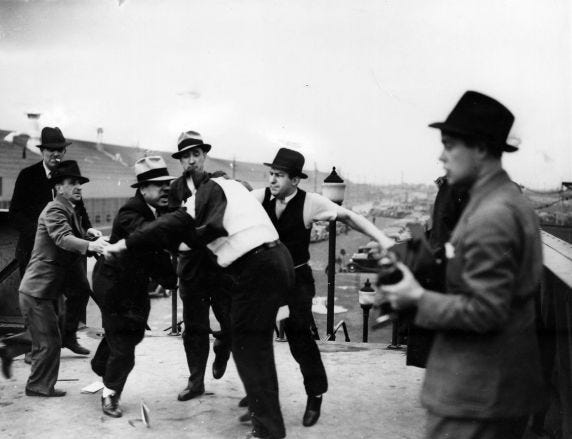
A photographer by the name of James Kilpatrick captured everything, including the photo above where Ford Motor Company Servicemen beat Richard Frankensteen, a UAW organizer, during the “Battle of the Overpass.” Ford’s men tried to destroy the photo plates. Kilpatrick hid the real ones under his car seat, drove away, and got the pictures to every newspaper in the country. Public opinion turned overnight.
1937 - Memorial Day. Fifteen hundred people marched toward the Republic Steel mill in South Chicago. Striking workers, their families, their neighbors. Three hundred police blocked the road. The crowd turned to leave.
The police opened fire on their backs.
Ten dead. Sixty-seven wounded. Twenty-eight skulls fractured by police clubs. Nine permanently disabled.
Paramount News filmed the entire thing. Then a Paramount executive suppressed the footage because he thought it might cause “mass hysteria.”
The coroner ruled it justifiable homicide.
No officer was ever prosecuted.
This wasn’t a few isolated incidents. In 1937 alone, four hundred and seventy-seven sit-down strikes involved roughly four hundred thousand workers across the country. Over the course of the decade, more than a hundred workers were documented killed by police and corporate militias.
Workers occupied factories. Burned company property. Fought Pinkertons with baseball bats. Shut down entire cities. Died on picket lines and in tent colonies and on steel mill roads while their children watched.
This is the part of American history that doesn’t make the textbook.
The Deal
Franklin Roosevelt did not create the New Deal because he was a good person.
He created it because the alternative was a revolution.
The Wagner Act of 1935 gave workers the right to organize. The Social Security Act of 1935 created a safety net. The Fair Labor Standards Act of 1938 gave them the minimum wage, the forty-hour week, overtime pay, and banned child labor.
These were not gifts, they were concessions.
Roosevelt knew exactly what he was doing. When critics said Social Security’s payroll tax was economically regressive, he didn’t argue economics. He argued power:
“I guess you’re right on the economics. They are politics all the way through. We put those payroll contributions there so as to give the contributors a legal, moral, and political right to collect their pensions. With those taxes in there, no damn politician can ever scrap my social security program.”
Politics. Not compassion. A calculation. Giving workers something was cheaper than losing everything.
The American middle class. The weekends. The pensions. The 8 hour workday. The idea that a factory worker could own a house and send kids to college. None of it was built on a foundation of democratic values.
It was built on broken windows and occupied factories and the well-founded fear of the ownership class that if they didn’t share the table, the table would be flipped.
The Rhyme
History doesn’t repeat. But it rhymes. And the rhyme scheme right now is deafening.
The squeeze, then - Twenty-five percent unemployment. No safety net. Company towns. Child labor. Workers had nothing and owners had everything and nobody with power saw any reason to change that.
The squeeze, now - Forty years of stagnant wages. Housing that costs more than most people earn. A gig economy dressed up as freedom. And an AI industry whose CEO tells a room full of investment bankers that intelligence will be “a utility people buy from us on a meter.” Then, in the same speech, admits that the balance between labor and capital is about to break.
The violence, then - Factory occupations. Sit-down strikes. Running street battles between workers and private armies. Tent colonies machine-gunned. Picket lines shot from behind. A million rounds fired at Blair Mountain.
The violence, now - A healthcare CEO assassinated in Manhattan and turned into a folk hero overnight. Thirteen bullets through a politician’s front door over a data center vote. A six-hundred-million-dollar fire set by a man who filmed it, posted it, and invoked the assassin’s name. A firebomb at the gate of the most prominent AI executive on Earth.
The concession, then - The New Deal. Social Security. The minimum wage. The forty-hour week. A generation of shared prosperity purchased with the currency of fear.
The concession, now - A thirteen-page PDF proposing robot taxes and a four-day workweek. Published four days before the author’s house was firebombed. Written by the same company that was lobbying against safety legislation with the other hand.
There is one crucial difference.
In the 1930s, there was an FDR. A leader willing to stand between capital and labor and broker a deal. His motivations were self-preservation more than solidarity. But he was there. And he had the political power to force concessions from people who would never have offered them voluntarily.
Who is the FDR now?
The current administration’s policy engine is the Heritage Foundation. Its surveillance infrastructure is built by Palantir. Its data is managed by Oracle. The machine that should be brokering a new social contract IS the machine doing the squeezing.
There is no one in power positioned to negotiate on behalf of the people watching their jobs get automated, their housing get financialized, and their healthcare get denied by algorithms.
The Uncomfortable Truth
Nobody wants to say this. Saying it feels like endorsing it.
The pattern suggests that violence works.
Not morally. Not as a philosophy. Not as something any sane person should pursue. But historically. As a matter of documented, repeated, verifiable fact. The American middle class exists because workers made the cost of exploitation higher than the cost of compromise.
The sit-down strikes worked. The factory occupations worked. The threat of revolution worked. Not because burning things is good. Because the people who owned everything only shared when they became afraid of losing it all.
That’s not a call to action. It’s a history lesson.
And a warning.
Sam Altman is publishing his version of the New Deal from a twenty-seven-million-dollar house four days before someone shows up at his gate with a bottle of gasoline. His proposal sounds exactly like the concessions of 1935. Robot taxes. Shorter workweeks. A public wealth fund. Just enough to keep the table from flipping.
Chamel Abdulkarim already gave his answer. He filmed it. Posted it. Lit the fire.
“All you had to do was pay us enough to live.”
Somewhere in an archive, there’s a Paramount newsreel from Memorial Day, 1937. Suppressed for decades because a studio executive thought the footage of police shooting fleeing workers in the back might upset people.
They buried that film. But the workers still won.
The question isn’t whether the concessions will come. History says they always do.
The question is how much has to burn first.
Sources
The Week of Fire (April 2026) - Indianapolis data center shooting (Washington Post, Apr 6) - Kimberly-Clark warehouse arson (LA Times, Apr 8) - Abdulkarim cites Mangione (Guardian, Apr 10) - Abdulkarim federal charges (NYT, Apr 10) - Sam Altman molotov cocktail (NYT, Apr 10) - Amazon warehouse fire, Ohio (Columbus Dispatch, Apr 8) - Bakersfield warehouse fire (Bakersfield Now, Apr 11) - Queens lumberyard fire (CBS NY, Apr 11) - Ohio lumberyard fire (WKYC, Apr 11)
Sam Altman / OpenAI - “Intelligence as a utility” quote, BlackRock Summit (Fortune, Mar 12) - “Intelligence as a utility” video (YouTube, BlackRock Summit) - OpenAI “Industrial Policy for the Intelligence Age” (openai.com, Apr 7) - Full policy PDF (openai.com) - Altman compares to New Deal (Axios, Apr 6) - “Regulatory nihilism” critique (Fortune, Apr 6) - AI job displacement confirmation (Fortune, Feb 19)
Luigi Mangione / Folk Hero Phenomenon - Mangione as modern antihero (New Yorker, Dec 13, 2024) - Pop culture Robin Hood (El PaÃs, May 21, 2025) - Social media folk hero (Forbes, Dec 12, 2024)
1930s Labor History - Homestead Strike (1892) - Ludlow Massacre (1914) - Battle of Blair Mountain (1921) - Minneapolis Teamsters Strike (1934) - West Coast Waterfront Strike (1934) - Flint Sit-Down Strike (1936-37) - Battle of the Overpass (1937) - Memorial Day Massacre (1937) - Wagner Act (1935) - Fair Labor Standards Act (1938)
Anti-Data Center / Anti-AI Movement - 12 states with data center moratorium bills (Washington Post, Apr 8) - FBI Carahsoft raid (Nextgov/FCW, Sep 2024)